
Nihao China pavilion opens window to culture at Berlin fair
Xinhua 2026-03-16 14:25:11
From an expanded visa-free transit policy to broader unilateral visa-free access, a series of measures is making China increasingly attractive to international visitors eager to explore Chinese culture, landscapes and unique travel experiences.
That growing appeal was showcased at ITB Berlin 2026, the global tourism trade fair that wrapped up its 60th anniversary earlier this month. The event once again drew tourism professionals from around the world, with the "Nihao China" pavilion generating strong interest among a steady stream of visitors throughout the fair.
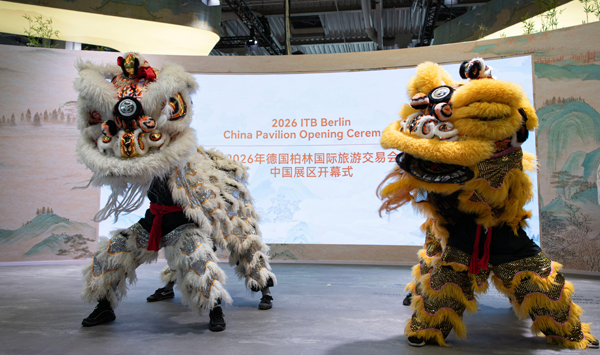 Artists perform lion dance during the opening ceremony of the China pavilion at the ITB Berlin travel trade show in Berlin, Germany, on March 3. [Photo/Xinhua]
"May I take a photo here?" a young blonde woman asked at the China pavilion, as she stood before a bamboo installation evoking the charm of a classical Chinese garden.
Carefully adjusting her Chinese-style outfit, she turned to her companion with a smile. "It feels like I've really stepped into an ancient Chinese painting."
Behind her, the pavilion unfolded in soft blue-green hues, echoing the elegance of classical Chinese aesthetics. Translucent hanging decorations, calligraphic design elements, and touches of bamboo gave the space a light, flowing feel.
"Traditional Chinese culture is one of the strongest draws of travel to China," says Jack Pinnick, an American who has lived in China for 16 years. This year, representing central China's Hubei province, he performed a Wudang martial arts routine at the China pavilion, drawing a steady crowd of onlookers.
Pinnick believes international interest in China is evolving. "In the past, many foreign visitors came to China with a fascination for kung fu," he says. "Now, more and more are being drawn by the depth and diversity of traditional Chinese culture. Many come the first time out of curiosity, but after experiencing it for themselves, they return because of its lasting appeal."
Lydia Li, deputy general manager of ITB China, says inbound travelers are increasingly choosing independent and flexible travel. Their interests are also shifting from traditional tourist hot spots to lesser-known destinations. As travelers look beyond first-time curiosity and checklist sightseeing in search of deeper experiences, the shift is reshaping tourism services.
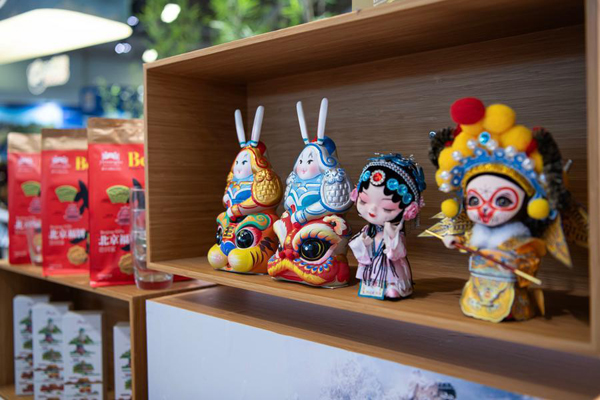 Cultural and creative products are displayed in the exhibition area of the China pavilion at the ITB Berlin travel trade show. [Photo/Xinhua]
At this year's event, China's smart tourism solutions have been another highlight. At the Berlin fair, Hongtu Zhixing Network Technology Co, a travel-tech company that applies artificial intelligence to travel services, showcased its Seeking China AI itinerary-planning engine, an intelligent recommendation system, and a one-stop platform for cross-border travel services.
Chen Nan, the company's product director, demonstrated how its AI system could create a food-focused itinerary taking travelers from Chengdu, Sichuan province, to Shunde and the Chaoshan region in Guangdong province, while arranging reservations at lesser-known but highly regarded local restaurants along the way.
"According to our internal data, inbound travelers who use our AI planning tool report more than 40 percent higher satisfaction with their itineraries," says Li Zhouzhi, the company's marketing director.
Albin Loidl, president of the German Travel Association, says China is attracting a growing number of German tourists with its rich cultural heritage and diverse natural landscapes. He says the German travel industry hopes to deepen cooperation with China so that more German travelers can explore the country.
That growing interest is being supported by broader efforts to improve services for inbound travelers. Zheng Hao, vice-chair and secretary-general of the World Tourism Alliance, says China has been working to make international travel easier through visa and customs facilitation, expanded flight connections and upgrades to tourism infrastructure.
(Xinhua)
责任编辑:王晓莹