
Tomb tributes bridge gap between centuries
China Daily 2026-04-06 12:18:21
In her hotel room in Hangzhou, Zhejiang province, 21-year-old Wu Yutong opened an online map and realized she was sleeping just a few hundred meters from the grave of a woman she had admired since middle school.
The woman was Qiu Jin, the revolutionary and feminist executed by Qing Dynasty (1644-1911) authorities in 1907 at the age of 31.
The next morning, Wu, a university student from Dalian, Liaoning province, went to find Qiu's grave.
On a bright morning on Jan 21, Wu walked through Gushan Hill on the shores of Hangzhou's West Lake. She passed crowds of tourists and souvenir sellers. The path led her to a quiet clearing ringed by pine and camphor trees where a white marble statue of a woman holding a sword stood.
Wu had brought two offerings: a bunch of chrysanthemums and a red silk scarf. The flowers were chosen for Qiu's poem about them. The red scarf symbolized the blood the revolutionary had shed for her beliefs. "The fire in her heart never went out," Wu said.
For an hour, Wu stood quietly before the statue. When passersby mistook Qiu for other figures — for instance the legendary snake spirit Bai Suzhen from Chinese folklore, or Communist martyr Jiang Zhujun — Wu told them the real story.
"I felt I had finally completed a conversation across time with the heroine that I had read about so many times," she said.
Wu first encountered Qiu in middle school, where she was reduced to a few lines in a textbook: a revolutionary martyr and a patriot.
It was only after reading Qiu's poetry and her essays in the Chinese Women's Journal, which the revolutionary founded in 1907, that Wu began to see her as a different person.
"I no longer saw just a name but a girl trapped by her era, one who fought desperately to break free," she said.
When Wu posted about her visit on the lifestyle platform RedNote, or Xiaohongshu, the response surprised her. The post has since received more than 35,000 likes. In the comments, she found a community.
Some asked where the statue is located. One painted a New Year's picture of Qiu with mountains and rivers on her robes — a symbol of the nation Qiu died for, while trying to change it for the better.
For Wu, Qiu is a mirror for her own life. "I remind myself to stand tall like her, to be the master of my own fate.
Of her hobby, she said: "I don't see it as chasing celebrities, but rather drawing strength from history. When we face challenges or feel lost in our own lives, thinking about the spirit of historical figures gives us courage to move forward."
"In the quiet of an ancient tomb, we can find in history the direction and confidence to keep going," she added.
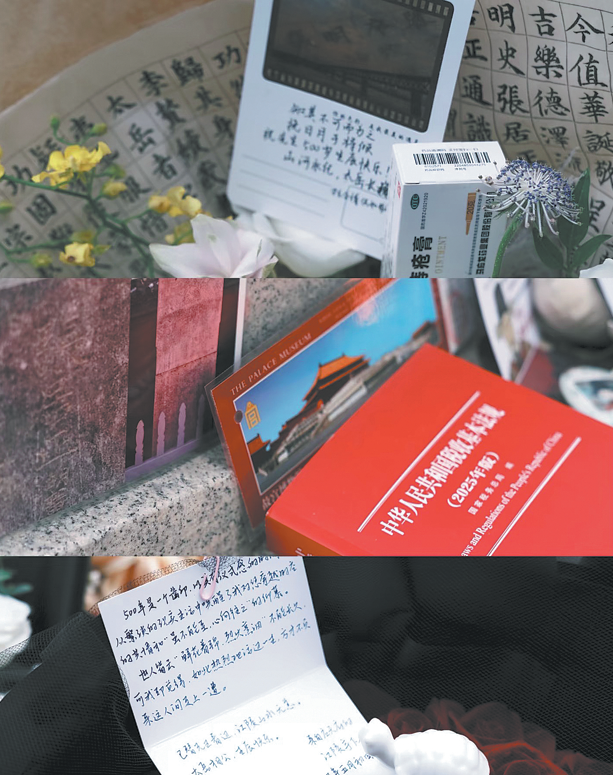 Modern gifts related to Zhang Juzheng's life are placed in front of his tombstone. CHINA DAILY
For Wu's generation, historical figures are no longer just names to be memorized for exams. They are becoming spiritual companions — people whose personal struggles make them relatable, and sometimes, even feel like friends.
Recently, many young Chinese have been turning historical sites into spaces for personal dialogues with the past. They are reviving history through pilgrimages to the tombs of ancient figures, leaving tributes that bridge the centuries.
At the resting places of poets, strategists and emperors, they offer not just flowers but carefully chosen tokens — fine wines for the legendary poet Li Bai of the Tang Dynasty (618-907), and painkillers for Cao Cao, a strategist who laid foundations for the Three Kingdoms period (220-280) who suffered chronic headaches. The trend, widely shared on social and lifestyle platforms, is an indication of a generation seeking connection beyond textbooks.
Tour guides are also focusing their efforts on such visits. In Luoyang, Henan province, a city rich in ancient history, tour guide Wang Mian has adapted to this growing trend among young people. Originally offering classic tour routes, Wang has turned his attention to tomb tribute visits, Beijing Youth Daily reported in September.
Tomb-sweeping tours started gaining popularity during last year's Qingming Festival, he said. He learned about the trend through online research and started tomb tours in July.
His tour groups include teenagers and university students, while parents have also joined the visits.
Wang said he is often struck by the visitors' deep historical knowledge and their ability to draw meaningful links across different dynasties. What began as an online trend has now become a new way to experience China's past, he said.
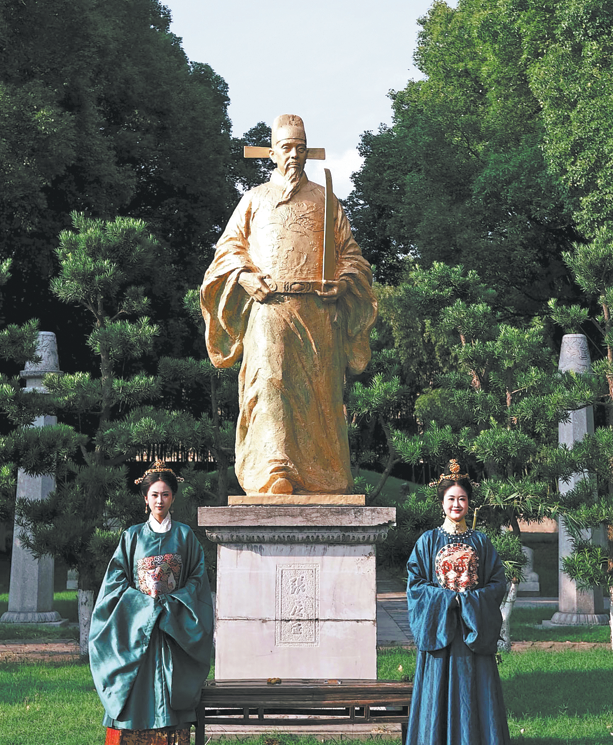 Clad in Ming Dynasty (1368-1644) clothes, Yu Yue (right) takes a picture in front of the tomb of Zhang Juzheng, a minister and reformer of the dynasty. CHINA DAILY
Yu Yue, a 30-year-old financial sector professional in Chengdu, Sichuan province, traveled to Jingzhou in Hubei province for something different last May. She went to celebrate a 500th birthday.
The guest of honor was Zhang Juzheng, the powerful Ming Dynasty (1368-1644) minister and reformer.
Yu didn't go alone, with a friend flying in from Beijing. In Jingzhou, they found a local stylist and dressed in Ming clothing. The tomb was quiet when they arrived, with only cypress trees and a few other young women who had come for the same reason. They were also dressed in the flowing silks of the Ming Dynasty, as if by prior agreement.
Yu and her friend brought gifts connected to the historical figure that would have likely resonated among fellow history lovers: a copy of the Tax Collection and Administration Law, a book on educational psychology, a small bag of soil from Beijing, the imperial capital, and a printed photograph of Zhang's name carved into a stone tablet at the Imperial Academy in Beijing.
Yu's interest in Zhang began with a middle school textbook and a line that read "senior grand secretary of the Ming Dynasty, architect of tax reform".
"I memorized it for an exam, not because I wanted to know him. I didn't have the life experience yet to understand," she said.
Years later, she picked up the book 1587, a Year of No Significance. It painted a tragic portrait of Zhang: a minister who essentially ruled the empire for a decade, only to be posthumously purged by the young emperor he had mentored. His family was destroyed.
It was the small details that made Yu want to stand before his grave.
"Historical records showed he was a man who loved bright clothes, used face cream and perfume daily, and groomed his beard carefully," she said.
"He had a meticulous approach to his appearance, which brought him down from the cold stone. He became relatable, even adorable — not just a hero, but a living person," Yu said.
"He was likable. Even people who disagreed with him politically seemed to like him. In real life, it's hard to get everyone to like you," she said.
Yu has pondered the significance of this connection.
"To stand before a grave is to feel the very pulse of our civilization. These figures connect us to our origins, transforming history from mere facts into a story of flesh and blood," she said.
"Death is not the end. Oblivion is. For as long as a name is spoken and a story is told, a soul endures. Our remembering becomes its rebirth, allowing the past to live again within us."
Yu believes historical figures like Zhang act like a mirror, revealing faith and easing doubts that have defined our own journeys. "These people give warmth to history. Each visit is a spiritual anchor, reminding us we are not bystanders, but part of this enduring river of civilization," she said.
(China Daily)
责任编辑:王晓莹