
Island turns ecosystem into financial asset
China Daily 2026-06-10 14:14:00
China's first independently certified carbon-negative island is continuing to demonstrate positive economic returns, providing a profitable, eco-friendly model for other areas around the country.
Lingshan Island, located 10 kilometers off the coast of Shandong province's Qingdao West Coast New Area in the Yellow Sea, recorded 706 million yuan ($97.3 million) in gross ecosystem product in 2024, a 14.3 percent year-on-year increase, marking three consecutive years of growth, according to Jinan Engineering Consulting Institute.
Gross ecosystem product is the total financial value that nature contributes to the economy.
 Lingshan Island sits some 10 kilometers off the coast of Qingdao, Shandong province. [Photo provided to CHINA DAILY]
The 7.66-square-kilometer island, home to 900 people, was certified by the China Quality Certification Centre as China's first "carbon-negative island" on Dec 31, 2021.
According to the certification, in 2020 the island generated 5,668 metric tons of carbon dioxide equivalent from energy use, agriculture and waste treatment, while its forests absorbed 7,001 tons. This resulted in net emissions of negative 1,333 tons.
This milestone was the result of years of sustained effort, with the island undergoing a steady green transition that has reshaped both daily life and economic development.
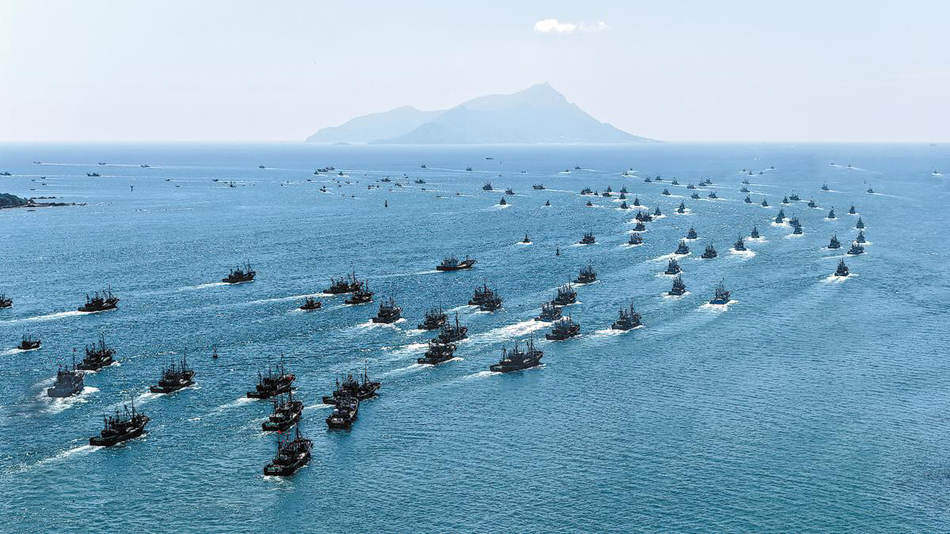 Fishing boats sail in the waters around the island. [Photo provided to CHINA DAILY]
Lingshan Island has carried out farmland-to-forest conversion since the 1980s. This long-standing commitment dovetails with China's dual carbon goals of peaking carbon emissions before 2030 and achieving carbon neutrality before 2060. The island has also taken part in pilot programs exploring how to balance economic development with environmental protection through carbon accounting.
Data from the Lingshan Island Provincial Nature Reserve Management Committee shows that more than 233 hectares of farmland have been converted back into forest, and over 2,000 free-roaming goats have been relocated to allow vegetation to recover.
In December 2002, with approval from the Shandong provincial government, the entire island and surrounding area were classified as a nature reserve, spanning 32.832 square kilometers. The classification aims to protect marine ecosystems, biodiversity, forests, bird species and geological formations.
According to the reserve's management committee, a large-scale restoration program, backed by an investment of 515 million yuan, has introduced measures ranging from shoreline protection and slope stabilization to oyster reef restoration and pollution control. More than 200,000 trees have been planted, 16 hectares restored and 15 hectares of oyster reefs rebuilt, alongside eco-friendly coastal upgrades and walking trails.
Technology is also playing a growing role in ecological management. The "Smart Lingshan Island" platform integrates big data, drones, satellite imagery and artificial intelligence to enable round-the-clock monitoring of the island's ecosystem.
In addition, a clean heating program has replaced coal with electricity in 455 households, reducing pollution and improving living conditions.
Island resident Teng Yanfang said the old coal stoves were a safety hazard. "With electric heating, our homes are warmer, cleaner and more comfortable," Teng said.
Outdated and unregistered vehicles have also been phased out, replaced in part by new-energy vehicles, helping build a greener transport system.
The conservation efforts have yielded effective results. Today, more than 80 percent of the island is covered in forest, while the surrounding waters remain clean and free of industrial pollution, the management committee said.
 Tourists visit an island lighthouse. [Photo provided to CHINA DAILY]
As tourism has grown, the livelihoods of the residents have gradually diversified. Tourists have come not only to enjoy home-cooked meals — largely seafood — but also to stay overnight or longer. In response, some families have opened guesthouses or invested in sightseeing vehicles to cater to the growing demand.
Chen Yiwen, 28, represents a younger generation embracing these changes. Six years ago, she returned to the island and renovated her family home into a homestay.
"We've turned old houses into stylish guesthouses so that every visitor wakes up to the sea breeze and a view of the ocean," she said, adding that this youthful approach aims to show Lingshan Island as more than a scenic getaway — it's a place where life itself can be savored.
So far, 53 homestays have been developed, supported by a local industry association that helps revitalize idle rural homes and older properties.
Currently, three regular ferry lines connect the island to the mainland, each providing a single round-trip service daily, weather permitting. Additional sailings are added during the peak travel season.
This strong ecological foundation has also added value to local aquaculture products.
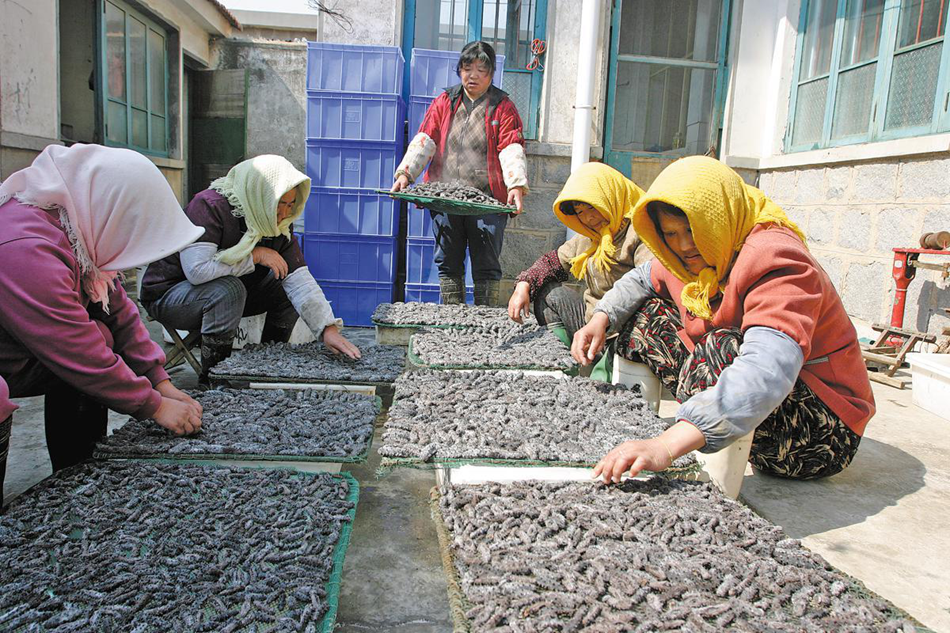 Farmers sort sea cucumbers raised near Lingshan Island. [Photo provided to CHINA DAILY]
In October 2024, Lingshan Island completed Qingdao's first carbon footprint assessment for a marine product — dried sea cucumber — produced by a local company. The result was 4.13 metric tons of carbon dioxide equivalent per ton of dried sea cucumber, earning the product a carbon label that helped boost sales by 40 percent year-on-year, according to the company's chairman Sun Jiguang.
"Sea cucumbers are highly sensitive to their environment," Sun said."Water quality, temperature, food supply and tidal conditions all affect their growth. The waters around Lingshan Island are ideal."
For businesses, carbon labeling enhances environmental credibility and strengthens consumer trust, said Sun Bin, an official with the reserve's management committee. "It also helps identify energy-intensive processes and improve efficiency, reducing both emissions and costs."
 An "I love Lingshan Island" sign is a popular photo spot on the island. [Photo provided to CHINA DAILY]
Visitors are also encouraged to take part in low-carbon living. A digital platform rewards actions such as waste sorting, green travel and reducing food waste with points that can be exchanged for daily goods.
Meanwhile, new growth drivers are emerging. The island is experimenting with low-altitude logistics, including drone delivery routes linking it with the mainland, while expanding marine tourism offerings such as coastal cruises and short island tours, said Zhang Jiatang, head of the economic development office of the reserve's management committee.
Financial innovation is also supporting development. Qingdao's first ecological asset-backed loan, worth 10 million yuan, and an 800,000-yuan green credit line for homestays have helped turn environmental assets into usable capital.
Yin Honglei, director of the reserve's management committee, said the island will continue to prioritize ecological conservation while further diversifying its businesses in an environmentally friendly way.
The goal is to keep the waters clean, the hills green and local livelihoods growing, showing how protection and development can move forward together, she added.
(China Daily)
责任编辑:王晓莹