
Exhibition makes mythical connections
China Daily 2026-06-20 09:05:00
In ancient Chinese myth, human beings were created by the mother goddess Nyuwa, who kneaded a mixture of soil and water until it took the form of a self-resembling doll-like creature. That myth is strikingly similar to one in remote Mesoamerica: in Maya myth, humans were made by a god who used maize dough.
Today, when visiting Mesoamerican countries, people find that maize remains the soul of local people's lives. It appears as the staple in daily meals, and is frequently added to other delicacies. Ceremonies related to maize can also be witnessed throughout the year.
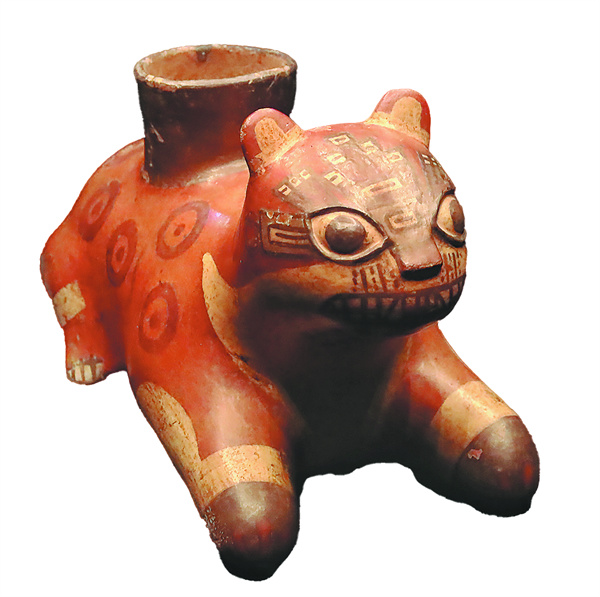 A feline-shaped ceramic jar, from 600 to 1000, unearthed in Peru. JIANG DONG/CHINA DAILY
This crop has been a lasting cultural symbol for millennia, as demonstrated by Maize. Gold. Jaguar: A Grand Exhibition of Ancient Maya and Andean Civilizations, which is currently on view at the Capital Museum in Beijing.
For over 3,000 years, from around 2000 BC to the 16th century AD, the Maya civilization flourished in present-day Mexico, Guatemala, Belize, Honduras, and El Salvador, renowned for its advanced writing system, astronomy and monumental pyramid-temples. Andean civilization, which thrived in South America's Andes Mountains from around 3000 BC to the 16th century AD, was also remarkable, known for its achievements in architecture, metallurgy and pottery production.
With about 800 artifacts from more than 20 cultural heritage institutes in Mexico and Peru, the exhibition, as the largest in the museum's history, showcases a historical lineage of more than 3,000 years through three cultural symbols — maize, gold and the jaguar — systematically demonstrating the productive foundations, spiritual symbols and power systems of Maya and Andean civilizations.
"Maize was the origin of life in ancient Mesoamerica," says Tan Xiaoling, deputy director of the Capital Museum. "Gold, in Andean civilization, was the sweat of the sun, representing the supreme authorities of divine and royal power. The jaguar, however, was the king of the forest and a symbolic totem connecting the human world with the divine realm. Together, they form a complete spiritual spectrum of ancient American people from survival to faith and then power."
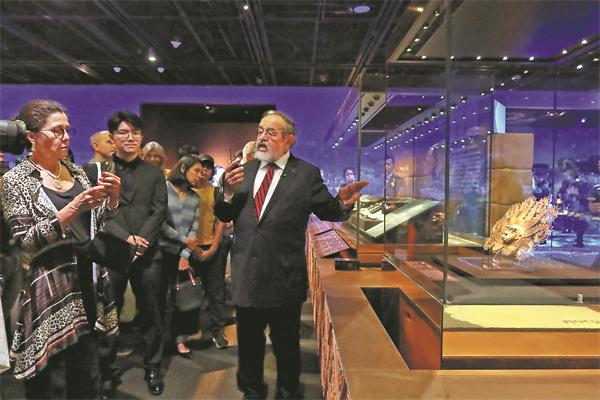 Peruvian archaeologist Walter Alva introduces artifacts from the Royal Tombs of Sipan on display at the Capital Museum's new exhibition last month. JIANG DONG/CHINA DAILY
Cosmic chapter
The first chapter draws visitors into the Maya world, displaying how ancient people from that remote area created outstanding achievements, including farming, hieroglyphic, and the astronomical calendar, during its classical era from 200 to 900, roughly the same time as China's Three Kingdoms (220-280) to the Tang Dynasty (618-907), says Shao Xinxin, curator of this section of the exhibition.
He highlights a sandstone head statue on display from 600-900, adorned with a cosmic tree headdress with geometrics, animal and deity patterns. It is speculated that this figure played an important role in ancient Maya sacrificial or other ceremonial activities.
Behind this artifact lies the Mayan worldview and the cosmos. Shao says they believed the world had three realms — the upper realm for the sun, the moon and the stars; the middle realm was where humans thrived; and the bottom realm was where the dead paused before rebirth. Linking the three realms is the cosmic tree, which holds the universe together.
Horizontally, with the tree at the center, Mayans divided the earthly realm into five directions, each associated with a symbolic color: the east, red; the north, white; the west, black; the south, yellow; and the center, green.
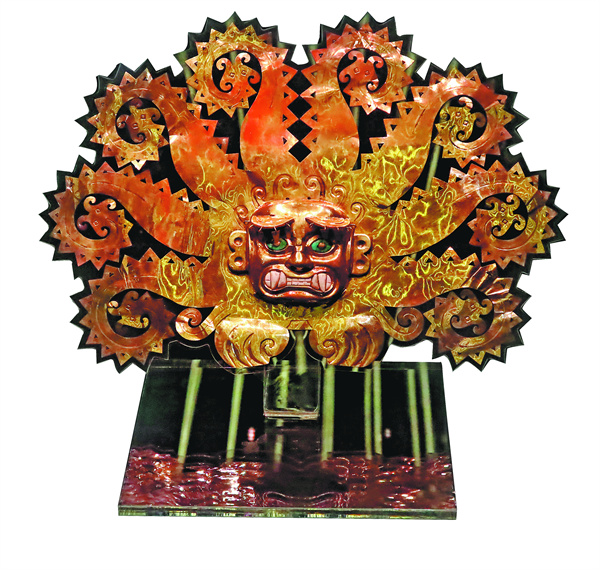 A gold headdress, unearthed in Peru from 100 to 850. JIANG DONG/CHINA DAILY
Shao says such ideas, whether the world is three realms or the five directions of different colors, can also be traced in traditional Chinese culture. The Chinese also used five colors to denote the same five directions, though the color assignments differed.
Another fascinating parallel appears in the representation of the moon. The display showcases a limestone stele from 900 to 1521 depicting the Maya moon goddess Ixchel. She holds a rabbit in her arms. In Maya belief, the rabbit symbolizes the moon and is an important partner of the goddess.
"This is highly similar to the moon goddess Chang'e and her rabbit in traditional Chinese myth," says Shao. "It is generally guessed that Maya and Chinese people both believed the shadow they witnessed on the moon was a rabbit. Connecting the rabbit to the moon is rare in world civilizations elsewhere."
While the exhibition's first section focuses on the Maya civilization, the second section shifts the viewer's attention southward into the Andes Mountains. Here, the organizing symbol is gold.
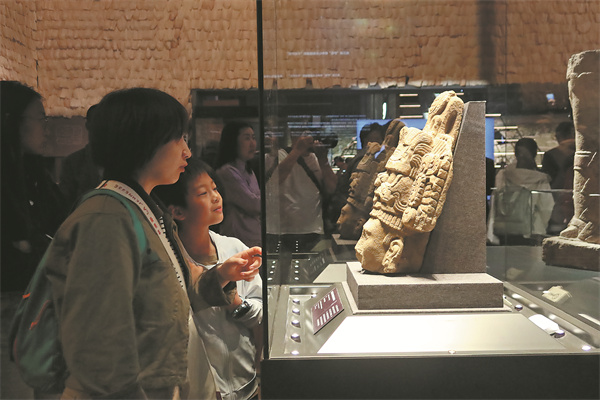 People appreciate a sandstone statue of Maya culture from 600 to 900 on display at the exhibition. JIANG DONG/CHINA DAILY
Heavy metal masks
In the second section, the Andean civilization is introduced mainly through its metal vessel-making techniques. A gilt-copper mask on display, unearthed from the Royal Tombs of Sipan in Peru, is the masterpiece that showcases this achievement. Its facial features are clear and lifelike, showing the craftspeople's mastery of human expression.
Such masks were often placed on the faces of tomb owners or appeared in groups as accompanying burial artifacts. In Andean belief, masks held a protective function: they guarded the soul of the deceased and helped the dead gain their identity in the underworld, says Zhao Yazhuo, also a curator of the exhibition, adding that the mask is highly similar to the jade and metal masks found in ancient Chinese tombs.
The 72 artifacts from the Royal Tombs of Sipan are highlighted in the display, with more than 80 percent making their debut in China. More than half have never been showcased in Peru.
The royal tombs were discovered first in 1987, when some were looted. Then archaeologist Walter Alva carried out rescue excavations of the tombs with a team and discovered the giant tomb group, where the king of the Moche culture (an ancient Peruvian culture from 100 to 850) was buried. Its high level of preservation is often compared to that of the tomb of Tutankhamun in Egypt.
"People in Peru's northern coastal region overcame the desert through engineered irrigation systems, giving rise to a unique civilization. The Moche culture, in particular, stands as an outstanding example," says Alva. "I believe this exhibition enables China, a country that also has a long history, to understand Peru's past and appreciate the best examples of its artistic creativity."
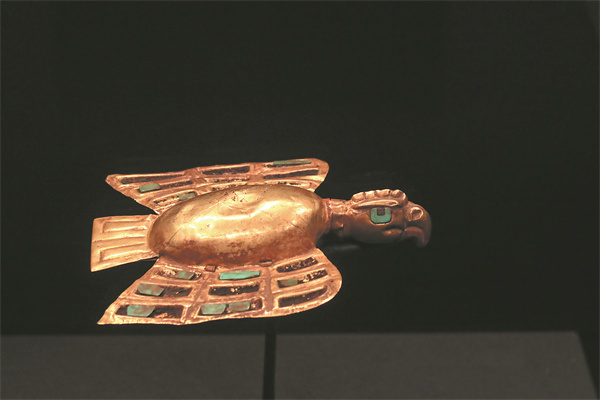 A gold Andean condor plaque from 1300-200 BC. JIANG DONG/CHINA DAILY
The exhibition also traces a lesser-known historical connection that linked the Andes to China through the global silver trade. Since the 16th century, when the Inca Empire (about 1400-1532) of Andean civilization gradually declined, Spanish colonizers exploited local silver in enormous quantities, which then traveled all the way to Ming Dynasty (1368-1644) China through maritime trade.
The Ming economy, Zhao explains, faced a silver shortage for use as currency. "The paper currency issued in the early Ming Dynasty had lost significant value, and there was also a shortage of bronze coins. Thus, the public had an earnest demand for a stable, reliable currency. The import of silver from Americas filled that gap.
"In this way, the remote Chinese and Andean civilizations were truly connected at that time, all becoming part of the entire world history," she adds.
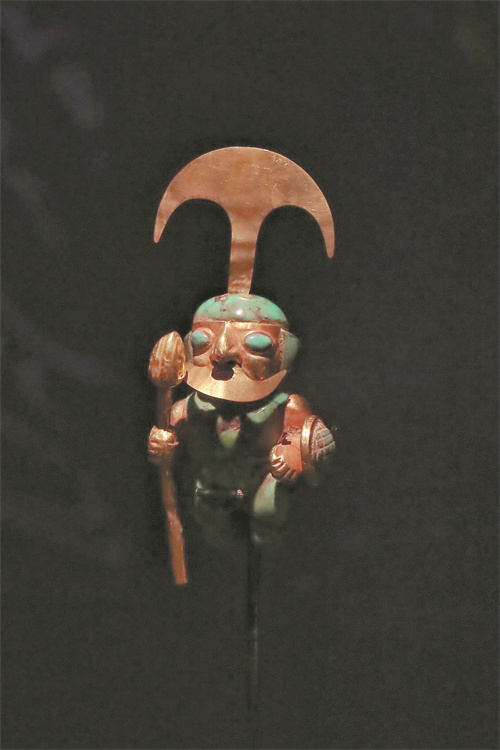 A gold Peruvian warrior figurine from 100 to 850 on display. JIANG DONG/CHINA DAILY
Animal instincts
While the first two sections focus on human creations, the final section turns the spotlight on animals in Americas, introducing their bond with human society.
Wei Yi, curator of the last section, says that in Mesoamerica, people believed each individual had a guardian spirit animal and was endowed with the spirit and character of their protective animal. For example, if someone's guarding spirit is a jaguar, then the person likely has strength and courage. If one is protected by a monkey, then they may be elegantly flexible with artistic talent.
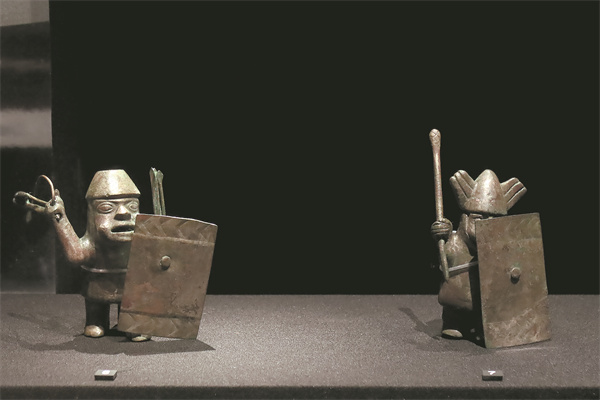 Bronze figurines unearthed from Peru from 600 to 1000. JIANG DONG/CHINA DAILY
An object on display directly illustrates this belief: a soldier's figurine in jaguar attire, found in western Mexico and dating from approximately 100 BC to AD 400. The soldier wears a jaguar skin as a garment, and his posture is aggressive and powerful. The meaning is clear: by dressing as the jaguar, the soldier would gain the animal's strength and fighting skills, ensuring victory in battle.
"Ancient people in Mesoamerica understood the relationship between people and animals in this way, deeply integrating animals in their lives and social culture," says Wei.
"Following this belief, visitors can find out their own guardian animal when touring the display," he adds.
(China Daily)
责任编辑:王晓莹