
Master's six strings strike global chords
China Daily 2026-06-23 16:30:00
Gao Yi, 56, is one of China's most accomplished classical guitarists. Today, however, he is winning even greater recognition worldwide as a luthier, crafting exquisitely handmade guitars that are earning international acclaim.
Two years ago, Gao's flamenco guitar won first prize at the 7th Antonio Marin Montero Guitar Building Competition held in Granada, Spain, where his classical guitar also remarkably made it to the final. He became the first Chinese luthier ever to win the competition's top prize.
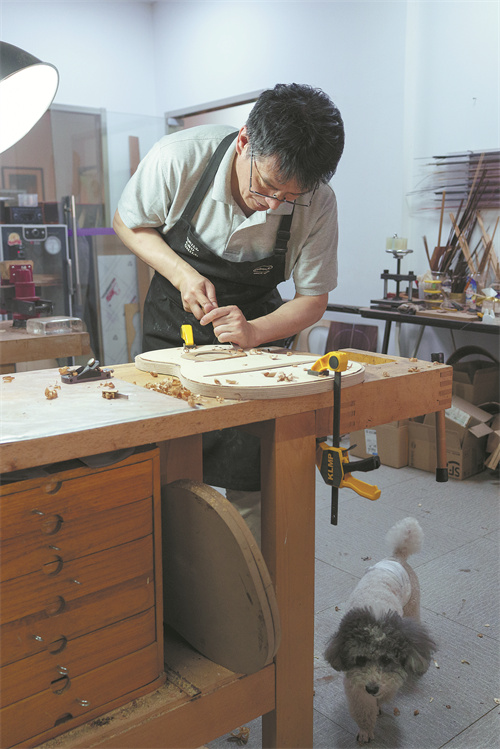 Gao builds a guitar at his workshop in Shanghai. GAO ERQIANG/CHINA DAILY
Last month, his instruments impressed Japanese musicians and fellow luthiers at an exhibition in Tokyo. Standing out in this highly competitive market through exceptional craftsmanship, Gao signed cooperation agreements with Japan's major instrument distributors, including Gendai Guitar and Kurosawa Gakki, for both online and offline orders.
Born in Shandong province in 1970, Gao's connection with music and instruments began early. He primarily played the Chinese bamboo flute as a child and taught himself guitar at the age of 17. After graduating from Jining University with a music degree in 1992, he continued his studies in classical guitar performance at the Central Conservatory of Music in Beijing the following year. It was there that he first encountered guitars built in the traditional Spanish style.
In 2000, Gao won first place in the Chinese Guitar Competition while performing on an Antonio Marin Montero guitar borrowed from a friend.
Later that year, he joined Yamaha Corporation as China's guitar market manager and relocated to Shanghai. During his eight years with the company, Gao deepened his understanding of guitar history and construction techniques. At the same time, he continued performing solo concerts, often using his cherished Marin Montero guitars.
His first attempts at building guitars began in 2010, when he established his workshop, Gaoyi Guitars. Shortly afterward, a serious accident during a repair left his fingers badly injured. Rather than discouraging him, the experience strengthened his determination to pursue lutherie more seriously and eventually shift his professional focus toward guitar making.
In 2013, Gao seized an opportunity to study traditional Spanish guitar-making in Beijing under Juan Labella, a respected guitar maker from Granada.
The following year, with support from the Spanish Consulate General in Shanghai, he visited Spain, where he was introduced to Marin Montero himself. The legendary master offered valuable guidance and encouragement. Marin Montero, widely regarded as one of the most influential living masters of traditional Spanish guitar making, became both a mentor and a lasting source of inspiration for Gao.
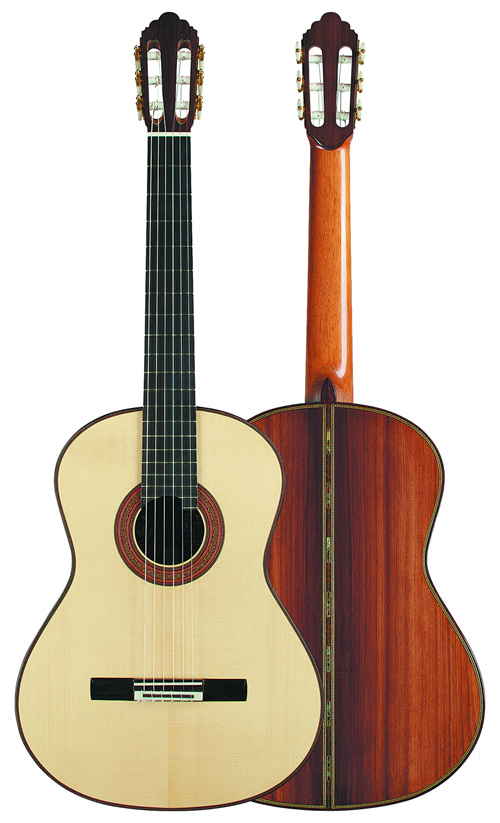 Gao Yi's classical guitar reaches the final of the 7th Antonio Marin Montero Guitar Building Competition in Granada, Spain, in 2024. CHINA DAILY
In 2019, Gao was recommended by the European Guitar Foundation to study with another renowned Granada School luthier, Rene Baarslag. The experience further shaped and inspired his own approach to guitar making.
"While I was in Spain, I lived with local musicians and luthiers to learn and exchange ideas. Then I realized that guitar making is far more than simply creating a seemingly abstract sound. Behind it lie the culture, history, humanism, life experience and the thoughts of the luthiers," says Gao.
Regardless of national or cultural differences, Gao says he was warmly welcomed by Spanish masters. They generously shared their workshops, materials, tools, techniques, craftsmanship, experience and even their philosophy of life.
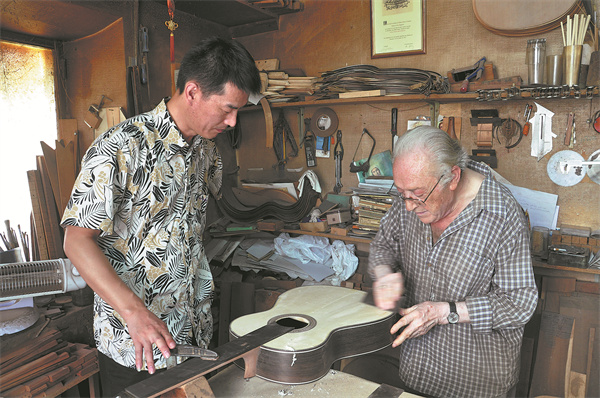 Gao with renowned Spanish luthier Antonio Marin Montero. CHINA DAILY
Gao says what many Chinese luthiers still lack in high-end guitar making is a deeper "understanding" and "perception" of the instrument itself. His experience as a performer has helped bridge that gap. Spain, widely regarded as the cradle of the classical guitar, has passed down its traditions and accumulated knowledge through generations of master builders.
It was during his time in Spain that Gao learned, for example, that the finest soundboards for premium Spanish-style guitars are often made from high-quality spruce sourced from the Fiemme Valley in the northern Alps at an altitude of around 1,500 meters. The same region supplied wood for the famed Stradivarius violins. Lightweight yet capable of producing remarkable clarity, the wood is highly prized among instrument makers. Gao also learned that every stage of guitar construction demands meticulous attention, from wood treatment and internal structure to component assembly and even the selection of the final finish.
"Guitar making is never like solving a math problem, and it doesn't have an exact formula. Every detail in the whole process comes from the accumulated experience of pioneers and also from luthiers' innovation. I see guitar making as a testament to collective creativity across generations," Gao says.
For Gao, guitar making is not merely craftsmanship but a form of "artistic creation". A guitar is far more than a box that produces sound; it is an artwork that reflects a maker's aesthetics, personality, life experiences and constant pursuit of innovation.
As technology advances and performance venues become increasingly diverse, guitarists are demanding more from their instruments, encouraging luthiers to continue pushing creative boundaries. Many modern classical guitars now incorporate aerospace technologies or carbon fiber materials into their soundboards to improve strength and project greater volume, particularly for larger venues and outdoor performances.
As a Chinese luthier proud of his country's rich cultural heritage, Gao has sought to incorporate elements of Chinese identity into his work. The rosettes on the two guitars that earned recognition at the Spanish competition draw inspiration from traditional Chinese geometric window-grille patterns combined with Japanese Hakone Yosegi Zaiku (marquetry wood mosaics), creating an elegant visual signature.
In other instruments, he frequently uses mother-of-pearl and shell carvings for decorative inlays. He is also exploring the use of locally sourced woods from different regions of China.
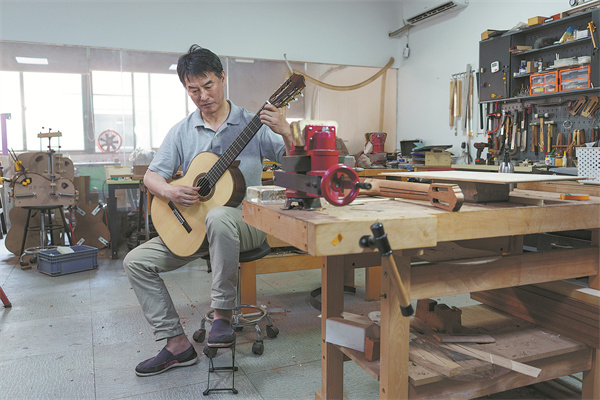 He tunes a guitar made at his workshop. GAO ERQIANG/CHINA DAILY
"We have already opened the door to the high-end guitar-making sector," Gao says. "As Chinese luthiers continue working toward the same goal and accumulating our own experience, I believe we will see more handmade guitars with a distinct Chinese identity shine on the global stage."
Building a high-quality guitar is a painstaking process. Working full-time as a luthier, Gao produces no more than 13 instruments a year. Benefiting from the keen tonal sensitivity developed during his years as a performer, he focuses on creating guitars with warm, delicate tones, rich dynamics, an authentic Spanish voice and a lasting Eastern character. His instruments are increasingly sought after by professional musicians and collectors from Germany, Spain, Japan, the United States and other countries.
As both a guitarist and a luthier, Gao has spent nearly four decades alongside the instrument he calls his "most loyal companion". The guitar has accompanied him through every stage of life, helping him express emotions, find friendship and resonance, and discover deeper meaning.
"The guitar is a record of my life," he says. "It contains my passion and what I hope to leave behind in the world. Even when my life comes to an end, my instruments will remain."
Asked about the secret to building a great guitar, Gao shares with China Daily an answer — and a life philosophy — that he first learned from Marin Montero: "Just slow down."
(China Daily)
责任编辑:王晓莹