
Factories encouraged to build up, not out
China Daily 2026-06-26 14:32:08
In Maanshan city's Bowang district, Anhui province, a newly expanded electrical plant has bypassed local land shortages by reinforcing its second floor to hold one metric ton per square meter — allowing heavy industrial spoolers to run high above the ground.
This vertical setup is a textbook example of "industry going upstairs", a national policy shift that encourages manufacturers to increase output from their existing footprints. By forcing factories to grow vertically rather than horizontally, the strategy keeps traditional manufacturing hubs viable, powers high-tech upgrades and protects the country's vital farmland.
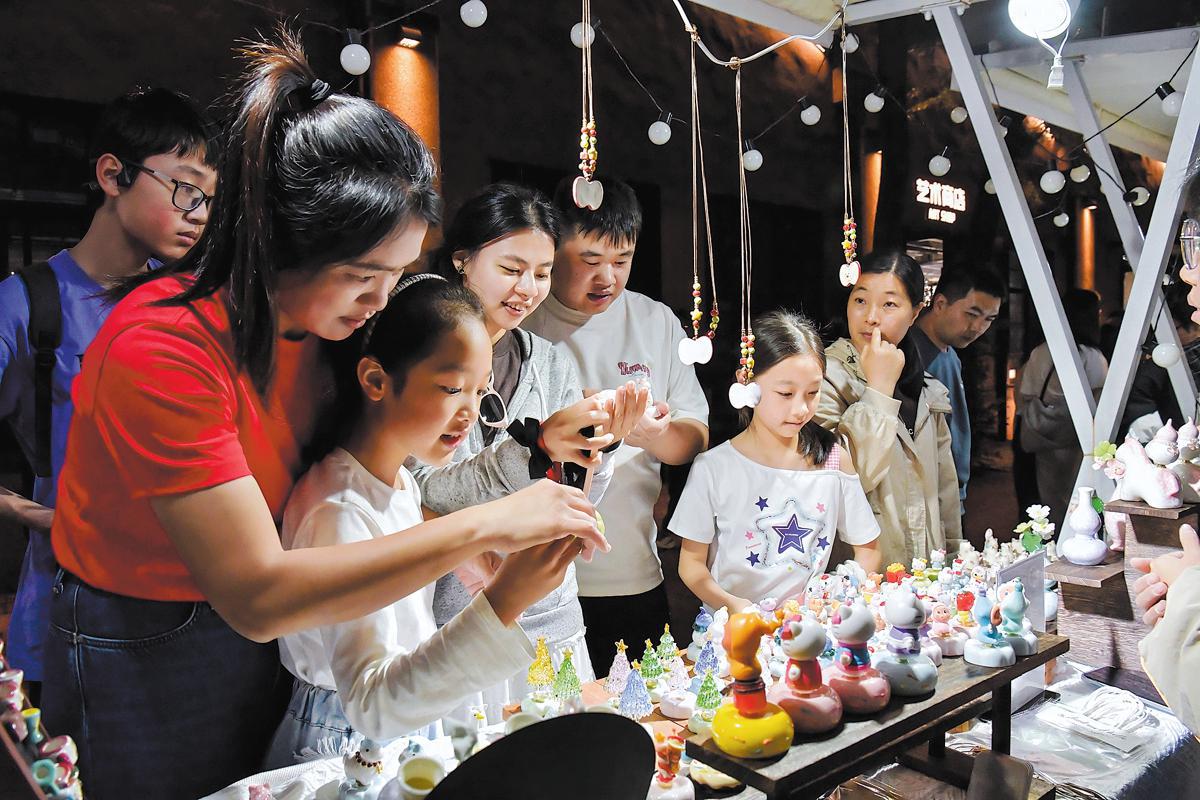 People browse souvenirs at Hongqi Fang, a redeveloped commercial complex on the site of a former porcelain factory, in Quanzhou, Fujian province, during the May Day holiday. CHINA DAILY
"It is not new land," said Jiang Donghang, general manager of Maanshan Shangdian Electrical Co, watching the copper strands feed into a spooler. "We consolidated several underused plots, demolished unsafe structures and built upward. On roughly the same area, we now have more than twice the usable floor space."
Jiang's factory is a microcosm of a national shift dating back to 2013 when the former ministry of land and resources introduced guidelines to address the inefficient use of land.
The Ministry of Natural Resources has since required that new construction land quotas be linked to local performance in revitalizing inefficient stock land. Supporting measures include greater flexibility in plot density, the issuance of special bonds to repurchase idle parcels, and the publication of model redevelopment cases to guide nationwide practice.
Progress under the pilot program remains robust. Data from the ministry shows that, as of the end of March, 100 pilot cities had launched redevelopment projects covering 79,800 cases, spanning 129,900 hectares.
During the 14th Five-Year Plan (2021-25) period, total approved construction land nationwide was 8.6 percent lower than planned ceilings. Land consumption per unit of GDP fell by 19.36 percent, while more than 400,000 hectares of idle land were returned to productive use.
Wang Zhengyi, an official with the Ministry of Natural Resources' department of natural resource development and utilization, said these figures mark a decisive shift away from decades of low-density peripheral expansion toward more intensive use of land within existing urban boundaries.
He said that the policy reorientation is driven by both constraint and calculation. China treats arable land as a strategic red line, with around 12 percent of its territory suitable for intensive cultivation to feed 1.4 billion people. As the economy pivots toward advanced manufacturing, green energy and digital infrastructure, the marginal returns from continued suburban expansion are diminishing.
The objective, he added, is to reshape urban growth by increasing output efficiency, aligning land supply with industrial upgrading needs, and easing pressure on farmland.
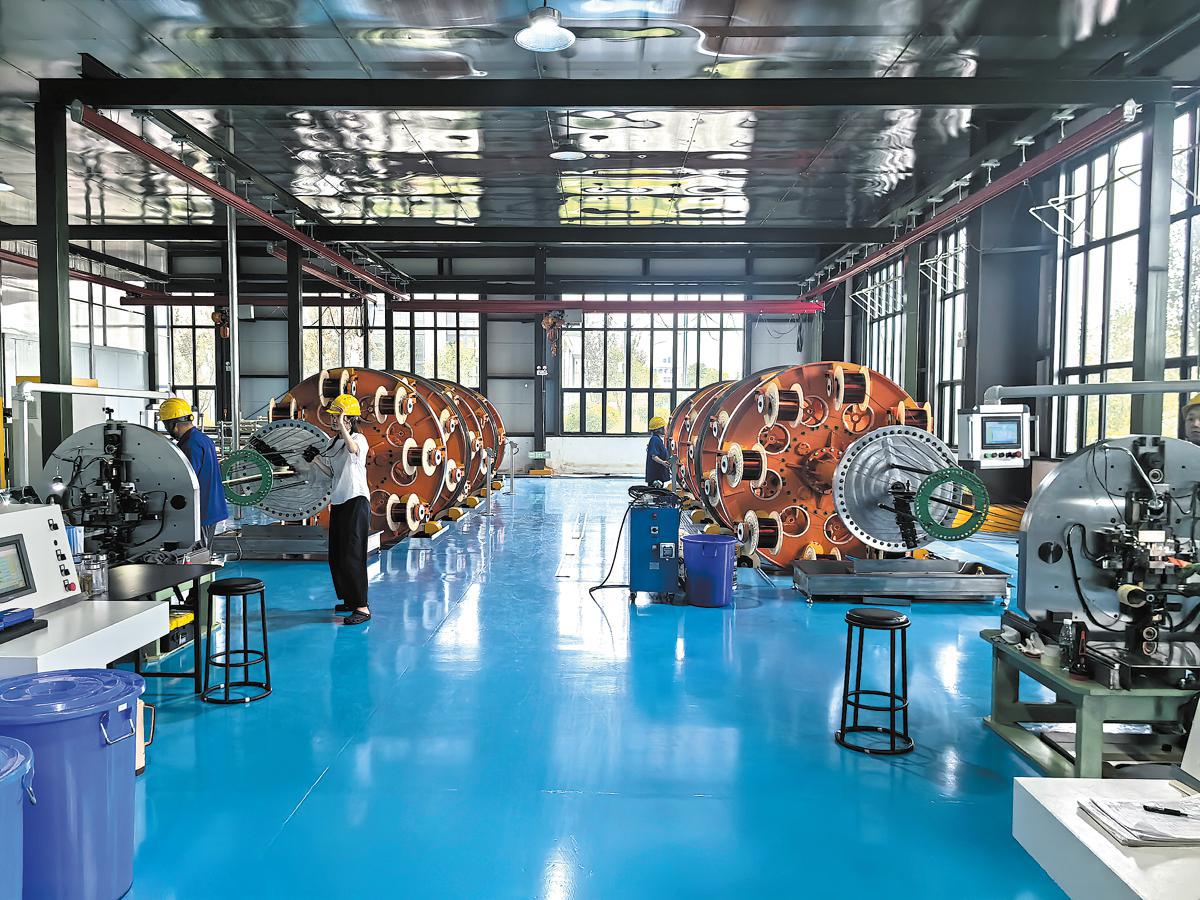 An expansion project increases the land use efficiency at Maanshan Shangdian Electrical Co. CHINA DAILY
This national strategy finds concrete expression in the city of Maanshan's Bowang district. Since the 1980s, small workshops and micro enterprises producing blades, dies and machine-tool accessories have clustered there. By the late 2000s, however, the developed area had become saturated. Scattered plots — many occupied by aging single-story plants with a plot ratio of barely 0.4, compared with more than 1.0 in modern industrial parks — left little room for expansion.
"We have little space for enlarging the development zone," said Chen Puwen, head of the Bowang division of the Maanshan Natural Resources and Planning Bureau. "If we wanted to keep traditional industry viable and bring in emerging industries, we had to look inward — consolidate fragmented lots, raise density and reallocate resources."
Bowang introduced a performance-based enterprise evaluation system for land allocation in 2018. Firms are assessed annually on land-output value, tax contribution, energy intensity, environmental compliance and workplace safety. Top performers receive priority when consolidated land becomes available. Lower-ranked firms are not forcibly removed; instead, they are relocated to standardized multistory plants, each occupying around five hectares, freeing original plots for higher-intensity use.
"The biggest hurdle in such consolidation efforts remains funding," Chen said.
To address this, Bowang secured 650 million yuan ($95.56 million) in 2021 through Anhui's bank loan program linked to land-intensification performance, with total credit extended reaching 3.22 billion yuan.
Chen added that the funds supported compensation, demolition of unsafe buildings, and construction of standardized plants with plot ratios rising to 1.5. To date, around 200 hectares of inefficient land have been cleared and repackaged across the district.
Jiang, the general manager at Maanshan Shangdian Electrical, grew up amid the clatter of grinding wheels and stamping presses that once earned Bowang its reputation as the hometown of cutting tools and molds. That strength, however, gradually became a constraint, as decades of scattered, lowrise workshops left little room for expansion.
In the 1990s, Jiang joined the ranks of local salesmen traveling across the country to sell Bowang's blades and molds. He later established a base in Nanjing in neighboring Jiangsu province, founding a business producing copper wire for power transformers.
"When I saw the district was serious about land consolidation (around 2019) and actively supporting emerging industries, I knew it was time to come back," Jiang said.
He acquired a 4,500-sq-m site in a Bowang industrial park in 2019, then successfully applied for one of the newly consolidated plots last year, securing space for expansion.
That original site is now being rebuilt into a 30,000-sq-m facility, with production lines upgraded to serve the national power grid and renewable energy projects. Rooftop photovoltaic panels have been installed to meet 70 to 80 percent of daytime electricity demand. Annual revenue now runs into the billions of yuan.
Jiang attributed the expansion in part to the district's land consolidation measures, which prioritize firms aligned with strategic emerging industries, including high-end electrical equipment.
"Electrification, EVs, energy storage, AI computing, all require transformers," Jiang said. "We're simply riding that current."
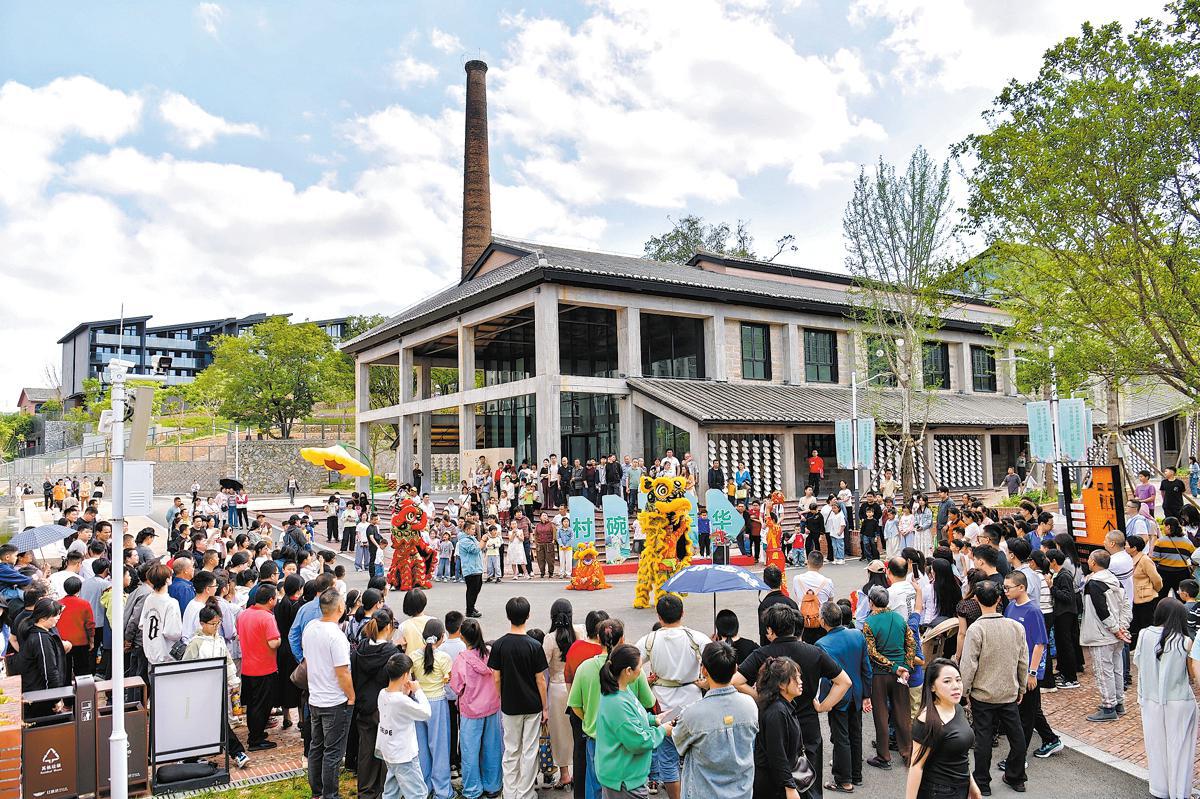 Lion dancers perform during a carnival at Hongqi Fang on May 1. CHINA DAILY
Reimagined returns
Further south in Quanzhou, Fujian province, a former porcelain factory in Dehua county illustrates a different pathway for low-efficiency land redevelopment — one centered on conservation, cultural revitalization and sustainable economic returns.
Founded in 1951, the Red Flag Porcelain Factory was once a pillar of Dehua's renowned translucent white porcelain industry, prized since the Ming Dynasty (1368-1644) for its purity and widely used in religious sculpture and fine tableware. After ceasing operations in the 1990s, its red-brick workshops, chimneys and wood-fired kilns sat idle as stranded assets in the center of a growing ceramics town.
Under the national low-efficiency land pilot program, the 97,000-sq-m site — now branded Hongqi Fang — was consolidated by a State-owned enterprise in 2021 and renovated into a commercial complex with a light-touch approach.
More than 40 percent of the built fabric has been retained as historical structures dating back over 50 years, including brick terraces, a centuries-old dragon kiln partially opened for public viewing, four signature chimneys and original timber roof trusses. Salvaged sagger bricks and kiln fragments have been reused in landscape design.
Functionally, the site has shifted from single industrial production to a composite model integrating manufacturing, exhibition, sales and tourism. The redevelopment introduced hotels, museums, a shared kiln, a ceramic authentication and auction center, and retail streets showcasing local crafts.
In addition, retired kiln workers and veteran artisans have returned as demonstrators and interpreters. On open days, they demonstrate wheel-throwing and glazing techniques, while also curating exhibitions of old payroll records, kiln logs and archival photographs, reconnecting visitors with the factory's industrial past.
Entering trial operation in 2025, Hongqi Fang spans 173,800 sq m and is projected to generate 300 million yuan in annual tourism revenue and attract 500,000 additional visitors per year.
The four chimneys, once symbols of industrial output, now frame a cultural-commercial precinct drawing large visitor flows. What was once idle industrial space has been revived — not by erasing the past, but by integrating it into a new economic and cultural future.
(China Daily)
责任编辑:王晓莹