
Following Edgar Snow into modern China
Xinhua 2026-07-20 16:52:58
At the entrance to the Red Army's western expedition memorial hall in Tongxin county, in Northwest China's Ningxia Hui autonomous region, a bronze sculpture of a young bugler gazes skyward. The figure evokes a pivotal moment in Chinese history, first captured 90 years ago by American journalist Edgar Snow.
The image later appeared on the cover of Snow's landmark book Red Star Over China, which introduced the Chinese revolution of the 1930s to readers around the world. This summer, nine decades after Snow photographed the young soldier, his great-grandnephew Samuel Maclean revisited the site with his own camera.
 Samuel Maclean (second from left), a relative of Edgar Snow, visits the Red Army memorial hall in Tongxin county, Ningxia Hui autonomous region, on July 6. [Photo/Xinhua]
"At this moment, I truly felt the heavy and long history in this place, and that's very meaningful," Maclean says.
Tongxin occupies a significant place in China's revolutionary history. It was where the country's first county-level Hui autonomous government was established, and later became closely associated with the Red Army's activities in Northwest China after the three main Red Army forces united at the end of the Long March (1934-36).
Earlier this month, Maclean joined representatives of the Edgar Snow Memorial Foundation and international scholars for a tour themed Retracing Snow's Route, visiting places tied to both Snow's original reporting and Tongxin's revolutionary past.
According to Sun Hua, director of the China Center for Edgar Snow Studies at Peking University, Snow arrived in Yuwangpu — now Yuwang town in Tongxin — in August 1936 and stayed for nearly a month, one of the longest stops during his journey through the Shaanxi-Gansu-Ningxia border region.
During that time, Snow interviewed Red Army leaders, soldiers and local residents. His writings portrayed disciplined Red Army soldiers and recorded their respect for the customs of the local Hui population. Tongxin, Sun adds, was a key site where Snow documented the Red Army's western expedition and policies on ethnic unity.
For several members of the visiting delegation, the trip also offered a chance to compare perceptions of China with the reality on the ground.
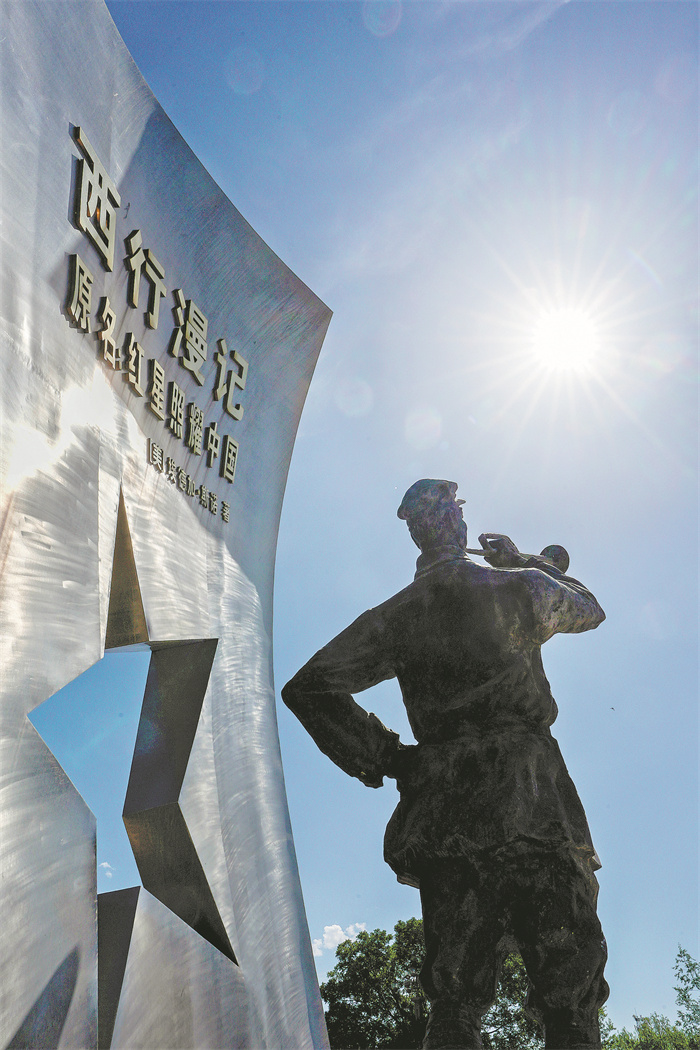 A statue of a young bugler stands at the Red Army memorial hall in Tongxin county. [Photo/Xinhua]
At the former site of the founding conference of the Yuhai county Hui autonomous government, which covered roughly the same area as present-day Tongxin, Egyptian scholar Mehad Mousa was struck by the county's historical significance.
"I learned that this represented the first county-level Hui autonomous region established under the leadership of the Communist Party of China, and one of the earliest examples of China's policy of regional ethnic autonomy," says Mousa, a scholar at Northwest University in Xi'an, Shaanxi province.
She says the visit challenged some of the narratives she had encountered outside China. "Just like the name 'Tongxin' itself, which means 'united as one' in Chinese, it embodies a spirit of peace," she says. "Everyone here lives together peacefully, regardless of what they believe in, where they come from, or which ethnic group they belong to."
If the Tongxin of Snow's era was defined by hardship, today's Tongxin tells a very different story.
In Red Star Over China, poverty was one of Snow's recurring observations about the county. Located in the Xihaigu region, Tongxin was once among China's harshest and poorest areas. Snow wrote that "over 70 percent of the local farmers were in debt, and about 60 percent were living on food bought on credit".
Sidne Ward, president of the Edgar Snow Memorial Foundation, says Snow described the people of Tongxin and Ningxia as poor but generous, sharing what little food and shelter they had with him.
"Today, my impressions are naturally quite different," Ward says. "While the warmth and hospitality of the people remain every bit as remarkable as Snow described, nearly everything else reflects an extraordinary transformation."
Tongxin's transformation is part of a broader national story. After a relentless eight-year campaign, China lifted all of its 98.99 million impoverished rural residents out of poverty by the end of 2020, eradicating absolute poverty that had long plagued the nation.
In Tongde village, a relocation community in Tongxin's Hexi town, rows of goji berry plants now stretch across the fields. The industry has helped more than 6,000 residents escape poverty, with many moving into more stable jobs in cultivation and processing.
According to local official Ding Lin, most households in the community now earn about 20,000 yuan ($2,939) a year, roughly four times their pre-relocation income.
"I saw a community that is building its own future," says Mohammad Saiyedul Islam, a Bangladeshi scholar at Sanming University in East China's Fujian province. "It is a powerful example that offers valuable lessons for other developing countries."
The visit also prompted reflection on the continuing relevance of the Long March spirit. The year 2026 marks the 90th anniversary of the victory of the Long March. In Tongxin, Snow wrote admiringly of the soldiers' endurance and their ability to bear hardship without complaint.
"I saw the core of the Long March spirit," says Rami Khalil, an Armenian-born professor at Sichuan International Studies University. "Ninety years on, the Long March is never a static, concluded chapter of history, but a perpetual, living spiritual journey that constitutes the unshakable soul of the Chinese nation."
For Ward, Snow's legacy also carries a message for China-US relations. She says the Edgar Snow Memorial Foundation has spent more than half a century promoting mutual understanding and friendship between the peoples of the two countries.
"We believe no relationship is more important to the 21st century than that between China and the United States," Ward says. "Through collaboration and friendship, we become stronger together."
(Xinhua)
责任编辑:王晓莹