
From Jordan to Beijing, young Sinologist builds literary bridge
Xinhua 2026-08-17 16:17:00
In a quiet neighborhood north of the Jordanian capital Amman, Manal Al-Khammash sits with unwavering focus before a guzheng, a traditional Chinese instrument, carefully plucking its strings and practicing one note after another.
Nearby is a collection of books, some Chinese classics and others contemporary works, offering a glimpse into a passion that has shaped much of her life: China and its culture.
"I started learning Chinese when I was 17. Now I am approaching 30, and I am still passionate about the language and culture," Al-Khammash says.
Her fascination with China began in childhood when she watched kung fu films starring Chinese actor Jackie Chan. The films ignited her curiosity about a distant country and prompted her to wonder about its language and people.
"Chinese pronunciation is so different from Arabic. How are these characters pronounced?" she recalls.
That curiosity eventually grew into a plan to study Chinese in high school and, later, into the determination to make the language her university major.
Learning Chinese was far from easy at the beginning.
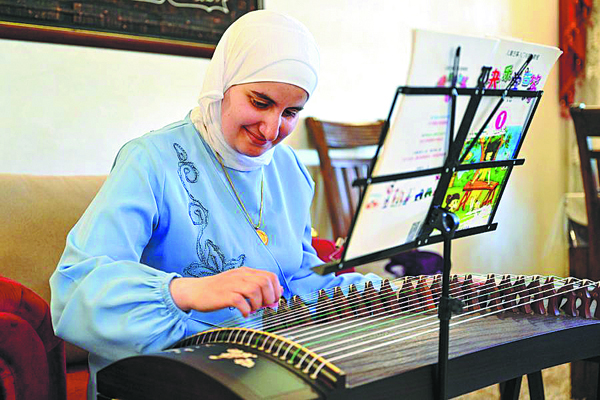 Manal Al-Khammash plays the guzheng, a Chinese zither, at her home in Amman, Jordan, on July 20. [Photo/Xinhua]
"Both the grammar and pronunciation were difficult," Al-Khammash says. But with her Chinese teachers' patient guidance, who carefully corrected her and followed her progress, together with her own persistent practice, she eventually mastered the pronunciation.
As her proficiency improved, she began to discover the joy behind the struggle. "I gradually started to feel the pleasure of learning and the sense of achievement that came with it," she says.
After graduating from the University of Jordan with a bachelor's degree, Al-Khammash realized that her knowledge of the language and understanding of China still needed to expand. With support from her family, she moved to Beijing in 2019 to pursue postgraduate studies at Beijing Language and Culture University.
As her mastery of Chinese grew, she began translating Chinese television dramas into Arabic. Seeing Arab viewers understand and connect with Chinese stories through her translations brought her immense satisfaction. It encouraged her to venture into literary translation, which, she soon discovered, demanded even more patience and effort. Yet for Al-Khammash, her passion made the challenge worthwhile.
Among her favorite works is Cold Nights, a novel by renowned Chinese writer Ba Jin (1904-2005). Although the story is set in China, Al-Khammash found in it emotions that transcend borders — the warmth of family relationships and the emotional struggles experienced by its characters.
That sense of shared culture inspired her to bring the novel to Arabic-speaking readers. Her translation was published in 2024.
During the process, Al-Khammash gave every character in the book Arabic names that she felt suited their personalities. She also included a detailed table at the end of the book explaining the original names of people and places, as well as the distinct cultural terms that appear in the novel.
Her goal was not simply to translate words, she says, but to open a window through which Arab readers could gain a deeper and more accurate understanding of Chinese culture.
"When I see Arab readers interacting with these Chinese stories through my translation — crying, laughing, and being moved by the characters — I feel an indescribable sense of pride and achievement," she says with a smile.
Today, Al-Khammash is pursuing a PhD in contemporary Chinese literature at Sichuan University. She spends most of the year in China and returns to Jordan mainly during academic breaks.
Her home on the northern outskirts of Amman reflects the life she has built between the two cultures. Chinese musical instruments, traditional tea sets and other Chinese cultural artifacts are displayed throughout the house.
Whenever friends visit and express curiosity about them, she eagerly introduces them to Chinese tea culture, preparing tea in accordance with traditional customs.
There is a difference between the two countries' tea traditions, she notes. In China, tea is often prepared using traditional brewing methods, whereas in Jordan, it is commonly boiled. Yet behind the different techniques lies a shared value: hospitality.
The deeper Al-Khammash delves into Chinese culture, the more similarities she discovers between the two societies: from filial respect for parents to reverence for teachers and elders and the willingness to help others.
"Many aspects of Chinese culture are similar to those found in Jordan and other Arab countries," she says.
For her, these cultural parallels have become a source of motivation to continue studying Chinese and researching its culture.
In May, she took another step toward advancing that mission by participating in a special China-Arab States session of the 2026 International Youth Poetry Festival.
At the Great Wall of China, beneath the red walls of the Forbidden City and at the Guangdong Literary Museum, she drew on her knowledge to help young poets from China and the Arab world communicate and connect.
For Al-Khammash, these encounters offered a firsthand glimpse of how exchanges between the two ancient civilizations can transcend geography and time. "I am willing to be a bridge connecting the Chinese and Arab cultures and to promote greater understanding between the two," she says.
Looking ahead to life after completing her doctorate, Al-Khammash has a clear vision: "I hope to work with Chinese people in the future, continue translating more Chinese literary works, and introduce more Arabs to the real and beautiful China," she says.
(Xinhua)
责任编辑:王晓莹