
Shandong's development story: Where innovation meets culture and ecology
chinadaily.com.cn 2026-08-24 17:42:49
Economic development is often measured through familiar indicators such as industrial output, investment, technological advancement and income growth. Yet the idea of sustainable development has broadened this understanding. Today, development is increasingly viewed as a process that must balance economic progress with social well-being, cultural identity and environmental protection.
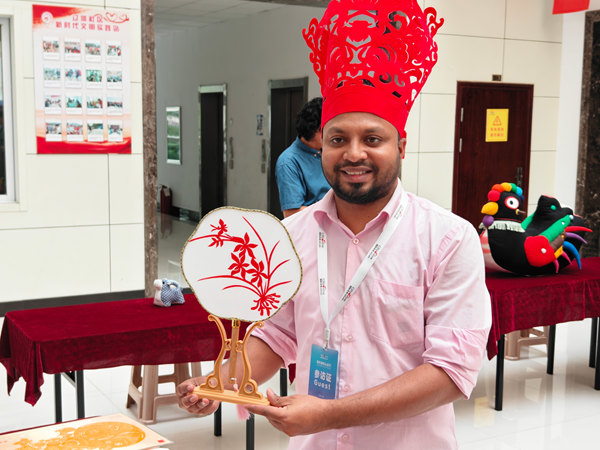 Mohammad Saiyedul Islam appreciates traditional Shandong paper-cut art works at the Liaohe Community in the Dongying Economic and Technological Development Zone. [Photo provided to chinadaily.com.cn]
A recent five-day visit to East China's Shandong province gave me an opportunity to observe this broader vision at the local level. Through firsthand experiences in Qingdao and Dongying, I saw how technological innovation, cultural preservation, rural vitalization and ecological conservation can be connected within a wider development strategy. Rather than treating these areas as separate priorities, Shandong appears to be exploring ways to make them reinforce one another.
Qingdao offered a particularly clear example of the role of innovation in modern economic development. The coastal city has long been known for manufacturing, trade and maritime industries. Today, it is also strengthening its position as a center for technological innovation, with artificial intelligence, intelligent manufacturing, biotechnology and other emerging technologies becoming increasingly integrated into production and services.
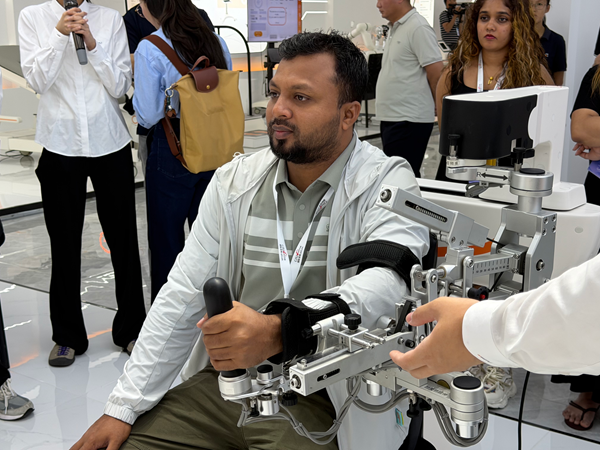 Mohammad Saiyedul Islam experiences an intelligent rehabilitation device during his visit to Kangdao (Qingdao) Medical Technology. [Photo provided to chinadaily.com.cn]
What impressed me most was that technology was not presented simply as a symbol of modernity. Its value was demonstrated through practical applications designed to improve productivity, upgrade industries and create new opportunities. This distinction is important. Innovation becomes meaningful when it addresses real economic and social needs and reaches factories, businesses, farms, public services and households.
For developing economies, the question is therefore not simply how to acquire advanced technologies. The more difficult task is to create an environment in which innovation can be widely adopted. This requires investment in education and skills, digital infrastructure, research, entrepreneurship and appropriate policy support. Countries that possess modern technologies but lack the necessary ecosystem may struggle to turn technological potential into broad-based development.
Qingdao also demonstrated that modernization does not necessarily mean leaving traditional culture behind. Alongside its modern industries and urban development, the city continues to preserve traditional food, tea culture, historic neighborhoods and local customs. These cultural resources are increasingly connected with tourism, creative activities and contemporary services.
This creates an interesting relationship between heritage and the modern economy. Cultural traditions can remain living parts of society while also contributing to local economic activity. Instead of viewing heritage merely as something to be preserved in museums, communities can find ways to keep traditions relevant to younger generations and contemporary consumers.
The same idea can be seen in Shandong's approach to rural vitalization. Rural development involves much more than constructing roads, buildings and other infrastructure. It also requires identifying the distinctive resources of rural communities and creating sustainable economic activities around them.
Traditional food, tea culture, agriculture, local heritage and rural landscapes can all become part of diversified development. When these resources are connected with tourism, cultural industries, modern agriculture and other services, rural communities can gain additional sources of income while strengthening their local identity.
Such development, however, requires careful planning. Commercialization can sometimes weaken cultural authenticity, while economic benefits may not always be distributed equally. Genuine rural vitalization therefore depends on community participation and on ensuring that local people are not merely observers of development but active participants and beneficiaries.
If Qingdao illustrated the relationship between innovation and modernization, Dongying provided a different perspective on development and ecological responsibility.
Located at the mouth of the Yellow River, Dongying occupies an important geographical and cultural position. The Yellow River is deeply connected with China's history, agriculture, and civilization, while its delta is also an ecologically sensitive area. Protecting this environment is therefore both an ecological responsibility and an important part of long-term development.
My experience in Dongying reinforced the idea that environmental protection should not be regarded simply as a constraint on economic activity. The protection of wetlands and the Yellow River Delta ecosystem can support biodiversity, improve environmental quality and strengthen the foundations for sustainable livelihoods.
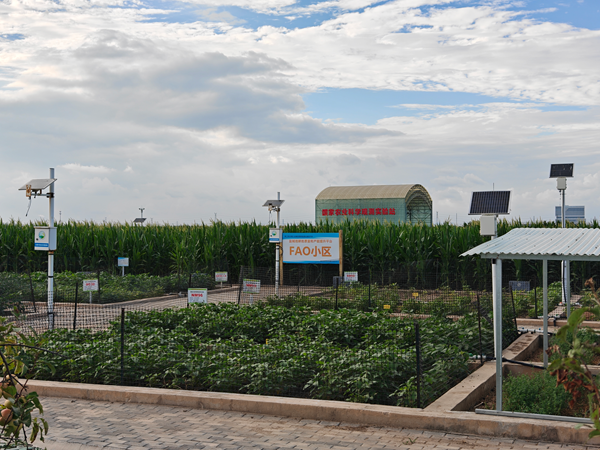 The experimental fields for saline-alkali land at the National Technology Innovation Center for Comprehensive Utilization of Saline-Alkali Land in Dongying. [Photo provided to chinadaily.com.cn]
The innovative use of saline-alkaline land was particularly striking. Land that presents difficulties for conventional agriculture can, through scientific research and technological innovation, be developed for productive purposes. This demonstrates how environmental challenges can sometimes become drivers of innovation.
Such an approach is increasingly important in an era of climate change, land degradation and water scarcity. Scientific research can help transform difficult natural conditions into opportunities for new agricultural practices, green industries and sustainable economic activities. The objective is not to choose between economic development and environmental protection, but to improve the quality of development so that both can progress together.
Dongying showed how an industrial economy can pursue ecological improvement and technological upgrading simultaneously. The city has an important industrial foundation, yet environmental considerations are increasingly incorporated into its development approach. This reflects a broader shift from an emphasis on simply producing more toward producing more efficiently and sustainably.
There are, of course, limits to what can be learned from any single region. Shandong's experience has been shaped by China's particular history, institutions, economic structure, infrastructure and geographic conditions. Approaches that work in China cannot simply be copied elsewhere. Their effectiveness depends on local governance, financial resources, human capital, education, infrastructure and community participation.
Nevertheless, the principles behind the experience have wider relevance. Development strategies can be more effective when technological progress responds to practical needs, when cultural heritage is incorporated into contemporary economic life, and when environmental protection is considered from the beginning rather than treated as an afterthought.
Perhaps the strongest impression from my visit was that modernization does not have to mean choosing between the old and the new, between industry and nature, or between economic growth and cultural identity. The more sustainable approach is to search for connections among them.
From Qingdao's innovation-driven industries and cultural traditions to Dongying's ecological conservation and efforts to use challenging land resources, Shandong presents different dimensions of a broader development story. Its experience suggests that high-quality development is not simply about faster growth. It is about smarter growth, more efficient use of resources, stronger communities and better opportunities for people.
For an international observer, field visits such as this are valuable because they bring development policies and concepts closer to everyday reality. Behind every technological project, cultural initiative and ecological program are communities seeking better livelihoods and a better future.
Ultimately, that should remain the central measure of development: whether modernization creates greater opportunities for people while protecting the cultural and natural foundations on which future generations will depend. Shandong's evolving experience offers a compelling example of how innovation, heritage and ecology can be brought together in pursuit of that goal.
Mohammad Saiyedul Islam, PhD, is a Senior Lecturer and Researcher in the School of Overseas Education (School of Foreign Languages) at Sanming University in East China's Fujian province, and a Research Fellow at the Sanming University-Shanghai International Studies University Joint Research Center for Hungarian Studies. He is also a Senior Research Fellow at the Daffodil International University Belt and Road Research Centre, Bangladesh.
(chinadaily.com.cn)
责任编辑:王晓莹