
Six amateurs, billions of views: AI creates hit historical drama
China Daily 2026-11-28 15:22:00
No stars, no trailer — just a time-travel short drama produced with artificial intelligence. Since its August launch, Chixie Rusong (Armed into the Song Dynasty) has garnered 12 billion views.
This hit was made entirely online by six amateurs, including a stay-at-home mom, a ride-hailing driver and a wholesale delivery worker.
The series is still updating and has reached Season 11, with more than 1,100 episodes in total, each running for less than two minutes.
It tells the story of five modern special forces soldiers who travel back in time to a small border village in the Song Dynasty (960-1279), personally taking part in and witnessing a series of important events and wars in Chinese history.
The drama features plenty of grand and meticulously researched ancient battle scenes. Crossbows, cannons and hot air balloons clash with ancient cavalry and infantry in striking visuals that viewers describe as thrilling.
On Bilibili, a video-sharing platform popular with younger viewers, more than 3,000 people are often still watching online even at 3 am.
Many viewers say the drama uses AI to "dream up" a history in which Yue Fei — a famous Song Dynasty general who fought invaders — survives instead of being executed, making up for a painful national regret.
What makes the drama more remarkable is that the entire process, from script and visuals to editing and music, was handled by six amateurs online.
Chief planner Zhang Hansheng, 54, had previously tried his hand at being an entrepreneur. Last year, he began exploring AI short dramas and spent more than 10 hours a day studying them. "AI has allowed ordinary people like us to achieve things we never dared to imagine. It has given ordinary people an equal opportunity," he said.
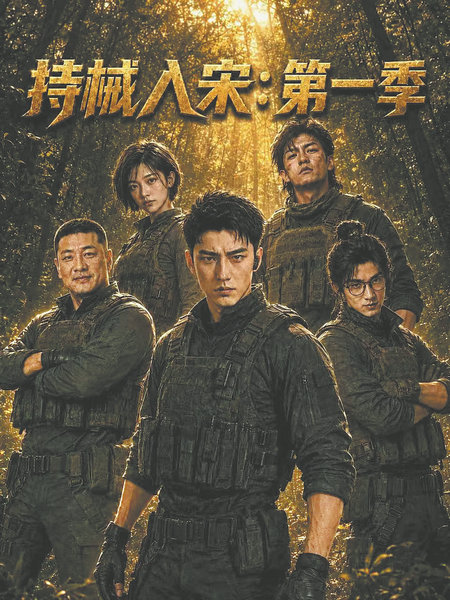 A poster for the AI-generated short drama Chixie Rusong (Armed into the Song Dynasty). [Photo provided to China Daily]
Two of the core team are women — one is a stay-at-home mom and another is a ride-hailing driver. By day they take care of children and make deliveries, while at night they sit down to make AI short dramas.
Director He Xiushan previously worked in design at a real estate company in Wuhan, Hubei province. After the short drama became a hit, he quit and went all in full-time. He said several team members are history enthusiasts and repeatedly check historical records to ensure that the visuals are accurate.
The original novel's author, whose online name is Chagen'er, is a 54-year-old English teacher from Harbin, Heilongjiang province. He said he consulted AI for several hours every day to verify historical details and collect materials.
Lin Qiwen, vice-president of DataEye Research Institute, said that among the massive wave of new AI short dramas, the share made by nonprofessional teams and ordinary people continues to rise, and Chixie Rusong is an outstanding example of this genre.
"It proves that after AI removes the barriers to filming, editing and visual production, film and TV productions with good storylines are no longer the sole preserve of professional film and TV crews," he said.
Data from the China Netcasting Services Association showed that in the first half of the year, more than 1,500 AI dramas entered the market every day on average. According to DataEye Research Institute, on Douyin alone, 221,900 AI dramas were launched in the first half of the year, and the user base of AI short dramas rose from about 120 million in 2025 to 600 million.
"Technology equality lowers the threshold and gives ordinary people a ticket to creation. There will be more and more independent creators," Lin said.
In his view, the advantages for ordinary people making AI short dramas are the extremely low trial-and-error costs, flexible subjects and closeness to audience emotions. Their exploration of different subjects can keep feeding new creativity into the industry.
(China Daily)
责任编辑:王晓莹